
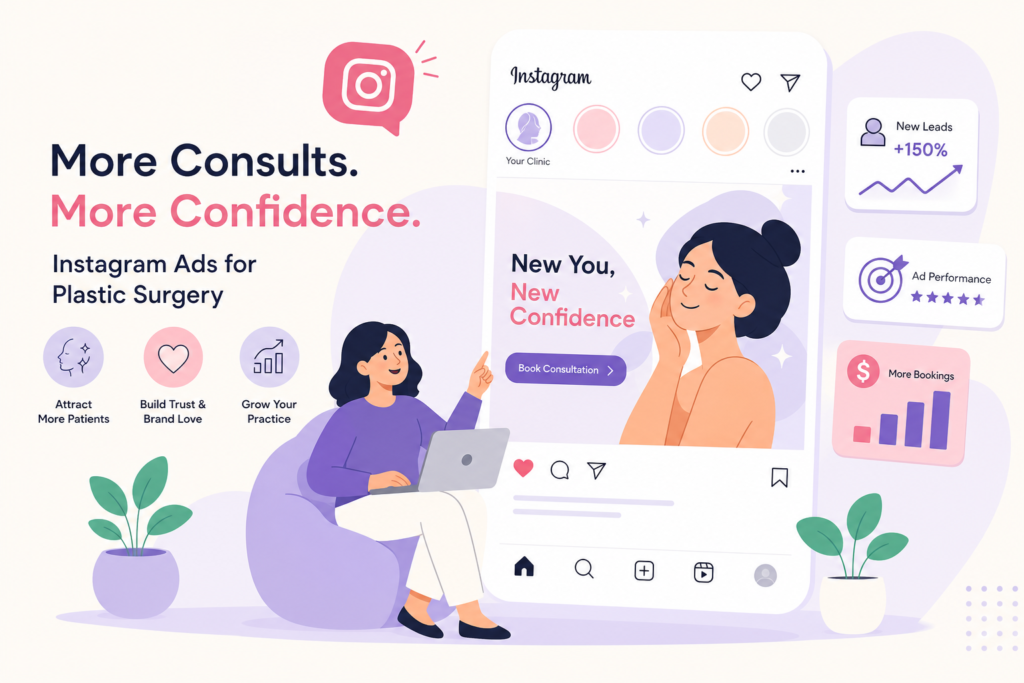
Instagram Paid Ads for Plastic Surgery Practices
Many aesthetic practices struggle with one of two approaches to Instagram advertising: either avoiding it entirely because it feels complicated, or running broad campaigns that burn through budget on clicks that never become consultations. Instagram paid ads represent one of the highest-ROI channels available to plastic surgery and medical aesthetics practices when structured correctly, and the gap between a wasted campaign and a profitable one comes down to a handful of deliberate decisions.
This article covers the full picture: why Instagram works structurally for this specialty, which ad formats convert, how to target precisely, how to keep your creative compliant, how to set up and read your campaign numbers, and how to turn a click into a booked appointment.
Why Instagram is the right platform for aesthetic patient acquisition
Plastic surgery and medical aesthetics are inherently visual specialties. The results live in before/after images, in the way a jawline photographs, in the subtle lift that makes someone look rested rather than operated on. Instagram is built for exactly this kind of visual communication, and its users tend to arrive in an aspirational mindset, actively seeking inspiration, comparing results, and forming preferences about what they want and who they trust.
How prospective patients use Instagram before they ever call
Patients don’t decide to book a rhinoplasty or a mommy makeover and then immediately call a surgeon. They research for weeks or months first. They save before/after posts, follow surgeons whose aesthetic they connect with, watch Reels about recovery timelines, and read comments about patient experiences. By the time they contact a practice, their opinion of that practice is already largely formed. Paid ads on Instagram intercept this research phase at exactly the right moment, putting your content in front of people who are actively building their mental shortlist.
What Instagram advertising does that organic content can't
Organic reach for business accounts on Instagram has declined significantly over the past several years compared with earlier platform norms, a trend widely documented across social media marketing studies. A post that might have reached thousands of followers in 2019 may now reach a fraction of that audience. Paid advertising solves the reach problem and adds something organic content never had: targeting precision. A rhinoplasty Reel can be placed specifically in front of women aged 25, 40 within a defined radius of your practice who’ve engaged with cosmetic and wellness content. That level of specificity isn’t possible with organic posting alone.

Instagram vs. other ad platforms for this specialty
Google Ads works on search intent, which is powerful for patients who already know what they want, but it’s text-heavy and doesn’t showcase visual results well. Facebook generally reaches an older-skewing audience with lower visual engagement for aesthetics content compared with Instagram. Instagram’s format, its Reels-driven engagement, and its audience composition make it a strong paid acquisition starting point for aesthetic practices in 2026. The two platforms often work well together, but if you’re choosing where to start, Instagram is the stronger beginning for visually driven specialties.
Instagram paid ads: ad formats that convert for aesthetic practices
Not every Instagram placement performs equally for surgical content. Each format serves a different role in the patient journey, and using the wrong format for the wrong stage wastes budget fast. The data is clear: Reels lead for CTR at 2.08% and ROAS at 3.12x, but Stories and Feed each fill specific gaps in a well-structured campaign. For a deeper primer on specific placements and creative sizing, see this Instagram ad formats explained.
Stories: urgency and direct offers for warm audiences
Stories ads run full-screen at 9:16 and work best for retargeting and offer-based messaging. A warm audience that’s already visited your website or watched a Reel responds well to a Stories ad with a direct CTA: “Book a free virtual consultation this week.” The format is brief by design, which forces clear and specific messaging. Don’t try to educate in Stories, save that for other formats and use this placement to prompt action from people who already know who you are.
Feed ads: education and trust at scale
Feed ads at 1080×1350 (4:5 portrait) suit educational content, credential-building, and testimonials. They’re less disruptive than Reels and receive more sustained attention from users who are actively browsing. A before/after carousel or a “3 things to know about rhinoplasty recovery” format fits naturally in this placement. Feed ads benchmark at $1.46 CPC and 1.41% CTR, lower than Reels, but the longer attention window makes them the right choice for content that needs a few seconds to land.
Targeting the right patients without wasted spend
The biggest mistake aesthetic practices make with Instagram paid ads is targeting too broadly or relying only on Meta’s interest categories. Large CPL variance, often driven by targeting strategy and creative alignment, is well documented in performance marketing for this vertical. A structured approach moves from cold to warm to hot audiences, with different creative and objectives at each stage.
Interest and demographic targeting as your starting layer
For cold audiences, layer demographic signals with aesthetic-adjacent interests: beauty, skincare, wellness, cosmetic procedures, and relevant lifestyle categories. Age and gender filtering matters significantly here. A breast reduction campaign targets a completely different demographic than a gynecomastia ad, and those differences should be reflected in your ad set structure, not collapsed into a single campaign. Geographic targeting should stay tightly defined around your realistic patient-draw radius, particularly for a New York City-based practice where hyper-local targeting can dramatically improve lead quality.

Custom audiences from website visitors and Instagram engagers
Any prospective patient who visits your website, watches a procedure video, or interacts with your Instagram profile is already a warm lead. Build custom audiences from these groups using Meta Pixel and Instagram engagement data. These audiences typically convert at lower cost because the trust gap is already partially closed. A patient who watched 75% of your facelift Reel and then visited your consultation page is a fundamentally different prospect than someone seeing your ad for the first time, your retargeting should treat them accordingly.
Lookalike audiences built from your existing patient data
Uploading a customer list of past patients, with appropriate HIPAA-compliant data handling, allows Meta to build lookalike audiences from the behavioral and demographic characteristics your best patients share. At 1% similarity, these audiences deliver strong precision. Widen to 2, 3% only when scaling spend and only after you’ve validated performance at the tighter match. This approach consistently produces lower CPL than interest targeting alone because you’re letting Meta’s algorithm find your most likely future patients based on real conversion data.
What Meta allows and what gets flagged for cosmetic content
Meta classifies cosmetic procedure advertising under policies that limit certain targeting options and require careful creative choices. Before/after imagery is permitted but cannot focus on negative emotional states, imply guaranteed results, or use language that emphasizes physical flaws or insecurities. The framing distinction is practical: content that positions a procedure as empowering and informative clears review more reliably than content that opens with a problem or a perceived deficiency. All cosmetic procedure ads must target users 18 or older, this is non-negotiable in your ad set setup.
The practices seeing results in 2026 treat each campaign as a learning loop
Instagram paid ads work for aesthetic practices when the targeting is precise, the creative is compliant and native-feeling, the format matches the patient’s stage in the journey, and the conversion path leads to a low-friction entry point. None of those elements are complicated in isolation. What separates profitable campaigns from wasted spend is the discipline to get all of them right simultaneously, and to keep improving through systematic testing.
Before spending on campaigns, confirm your foundation is in place: consistent Instagram content, Meta Pixel installed and verified, and a dedicated consultation booking page that loads fast and converts. Those three things aren’t prerequisites you can skip. Once they’re in place, even a modest daily budget can start generating qualified consultation requests if the creative, targeting, and offer are aligned.
The practices with the strongest results in 2026 treat every campaign as data, not a one-time spend. Each creative test teaches you something about what your prospective patients respond to. That knowledge compounds, a hook that lifted CTR in one campaign becomes the baseline your next test has to beat. Practices that build that testing discipline consistently outperform those running the same campaign indefinitely. Start with one format, one audience layer, and one clear CTA. Measure. Improve. Scale what works.